
What to Do the Week Your Child Is Diagnosed With Dyslexia

By Troy Hubbell, CALT | Certified Academic Language Therapist | Your Dyslexia Expert

You just got the diagnosis. Maybe you already suspected it. Maybe it came out of nowhere. Either way, you are probably feeling a lot of things at once, and that is completely normal. Many parents feel a sense of relief or vindication that they finally know what is happening to their child, overwhelmed and panicked about how to help, or both.
This post is for that moment. Here is what to do in the week your child is diagnosed, one step at a time.
First: Take a Breath. Your Child Is Still the Same Child.
Before anything else, I want you to hear this.
Your child was the wonderful, amazing person they were before you had a name for why reading was hard for them. They are still that same wonderful kid now. Nothing important has changed. You just know more about them than you did before, and they know that what they are going through has a name, that they are not alone, and that they are not stupid.
The diagnosis is not a verdict. It is a map. It tells you where the difficulty is and where the road forward goes. That is a gift, even when it does not feel like one.
Day One: Understand What You Are Working With
Dyslexia is a neurological, language-based learning difference. It is the most common learning difference, affecting roughly one in five people. It is not a reflection of intelligence, effort, or parenting. The brain of a person with dyslexia is simply wired differently in the area that processes the connection between sounds and letters.
The most important thing to understand is this: dyslexia does not get better on its own. It responds to the right instruction, delivered in the right way. That instruction is called structured literacy, and it is grounded in decades of research from the science of reading.
The good news, and it is genuine good news, is that with the right support, most children with dyslexia can become skilled readers. The gap can close. The trajectory can change. But it needs to be addressed, and sooner is better than later.
If you want to go deeper on understanding what dyslexia actually is and how it works, Overcoming Dyslexia by Dr. Sally Shaywitz is the book I recommend most often to parents. Dr. Shaywitz is one of the most respected researchers in the field and the book is written specifically for families, explaining the science in plain language. One caveat worth knowing: the book discusses a relationship between IQ and reading that more recent research has moved away from, so take that particular piece with some nuance. Overall it remains the best book available for families navigating a new diagnosis and is accurate and trustworthy in nearly everything it covers.
Day Two: Gain an Understanding of Your Child’s Strengths and Weaknesses
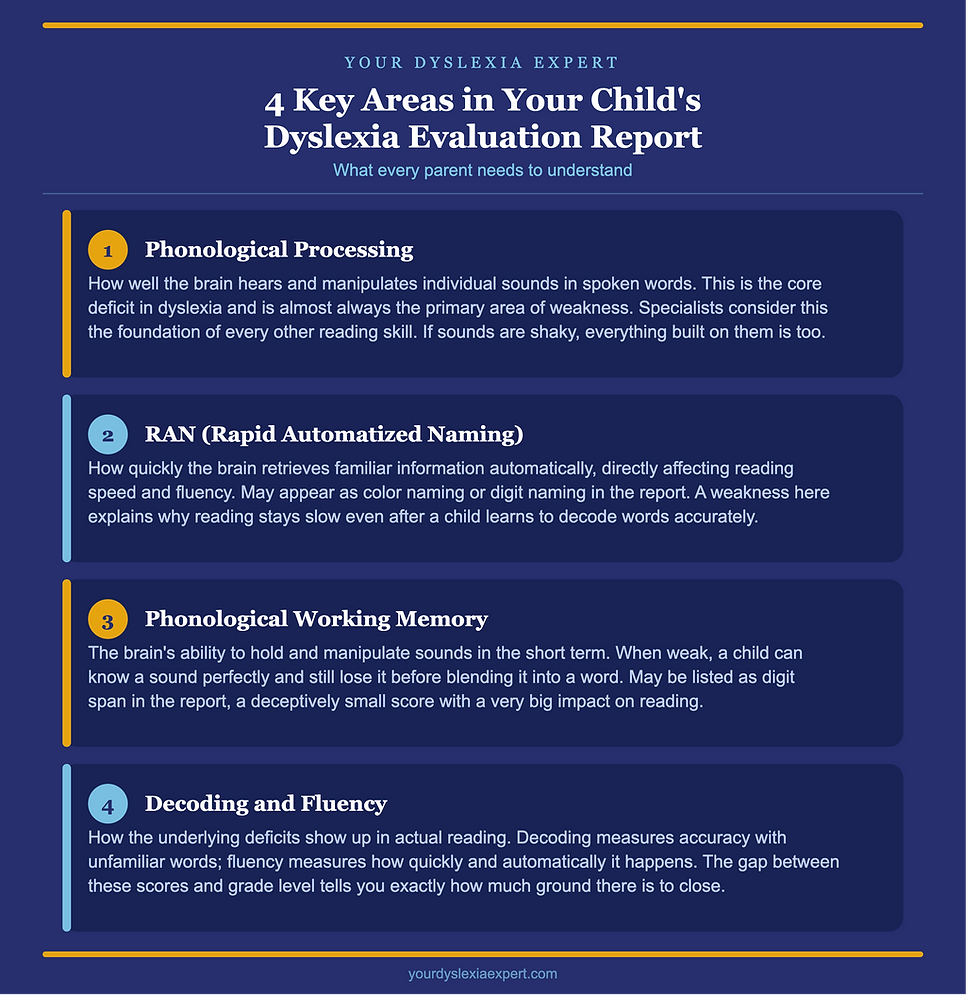
Before you can help your child, you need a clear picture of where they are excelling and where the gaps are. If the diagnosis came with a full neuropsychological or psychoeducational evaluation, sit down with it carefully. The four areas most worth understanding are phonological processing, RAN, phonological working memory, and decoding and fluency. Each of these tells a specialist something different about how your child’s brain is approaching reading and what kind of instruction will help most.
Phonological processing measures how well the brain can hear and manipulate the individual sounds in spoken words. This is the core deficit in dyslexia and is almost always the primary area of weakness.
RAN stands for Rapid Automatized Naming. This measures how quickly the brain can retrieve familiar information automatically, which directly affects reading speed and fluency. In some reports it may be listed as color naming or digit naming rather than RAN.
Phonological working memory measures the brain’s ability to hold and manipulate sounds in the short term while processing language. This is sometimes called digit span in evaluation reports. When this is weak, a child can know a sound perfectly well and still lose it before they can blend it into a word.
Decoding and fluency scores tell you how the underlying deficits are showing up in actual reading. Decoding measures whether your child can accurately read unfamiliar words. Fluency measures how quickly and automatically they can do so. Both matter, and the gap between them and grade-level norms tells you how much ground there is to close.
Evaluation reports can be dense and confusing, full of clinical terms and score labels that are hard to interpret without a background in testing. Do not let that stop you from understanding what the report actually says. Whoever conducted the evaluation should be willing and able to explain every score to you in plain, everyday language. If they cannot do that, or if you leave the meeting still unclear about what the numbers mean for your child specifically, ask more questions. Keep asking until you understand. You are your child’s best advocate, and you cannot advocate effectively for something you do not fully understand.
If the diagnosis came from a screener rather than a full evaluation, a more comprehensive evaluation is worth pursuing. The fuller the picture, the better equipped any specialist will be to help.
Day Three: Ask the School for Help in the Right Way
Knowing your rights is one thing. Using them effectively is another. We have a full guide to navigating the school system at The Insider Guide to IEPs and Getting Help From Your Child’s School, but here is the short version.
You have the legal right to request a special education evaluation in writing at any time. After you submit that request, the school has ten calendar days to respond. They either need to explain in writing why they are declining, or they need to begin the evaluation. In most cases they will proceed with testing.
Submit the request by email. Include the principal, your child’s classroom teacher, and a special education teacher on that email. For dyslexia, ask for an evaluation for a specific learning disability in the areas of basic reading and written expression. The school may not use the word dyslexia. That is fine. A specific learning disability in basic reading is what schools call dyslexia.
One important thing to understand before you go into this process: the criteria used to diagnose dyslexia privately and the criteria used to qualify for an IEP are not the same. A private neuropsychological evaluation and a school evaluation operate under different standards and different frameworks. Having a private diagnosis of dyslexia does not automatically mean your child will qualify for special education services, and the school is not necessarily acting in bad faith when they reach a different conclusion. They are simply using different criteria.
Being evaluated and qualifying for services are two separate questions. Many children with real deficits will not meet the threshold for an IEP. If your child does not qualify, a 504 plan is worth pursuing. A 504 has a lower eligibility threshold and can put meaningful accommodations in place, including extended time and text-to-speech tools, without requiring a special education placement.
The school process can be genuinely difficult to navigate, especially when you are also dealing with a new diagnosis and everything else that comes with that. If you need help, a qualified local special education advocate is one of the most valuable resources available to you. An advocate knows your state’s specific rules and procedures, can help you understand what your child is and is not entitled to, and can sit with you in IEP meetings so you are not navigating the room alone. Your local IDA branch, the International Dyslexia Association at dyslexiaida.org, can often point you toward one.

Day Four: Find a Qualified Specialist
At Your Dyslexia Expert, finding the right specialist for your child is something we think about every day. We are a team of credentialed dyslexia specialists who provide high quality remote structured literacy instruction at an accessible price point. Every member of our team holds recognized credentials in structured literacy and dyslexia. School advocacy is included with every tutoring relationship at no additional charge, which means you have an expert in your corner for both the reading instruction and the school navigation. If you would like to learn more or schedule a free consultation, you can visit us at yourdyslexiaexpert.com.
If you are exploring other options, here is what to look for in any specialist. The three accrediting organizations whose credentials matter most are the International Dyslexia Association at dyslexiaida.org, the Center for Effective Reading Instruction at effectivereading.org, and the International Multisensory Structured Language Education Council at imslec.org. You can search for credentialed practitioners through the IDA provider directory at dyslexiaida.org/provider-directories and the ALTA directory at members.altaread.org/Find-an-ALTA-Professional.
When you speak with any potential specialist, ask how they would assess where your child currently is, how they would use that information to individualize instruction, and how they track and communicate progress. A skilled specialist should be able to answer these questions clearly and specifically. A vibe check matters too. Your child needs to feel comfortable with whoever they work with, and a tutor who connects well with their student will get more out of every session than one who does not.
Day Five: Start Reading Aloud to Them Today
While you are finding a specialist and getting the school process started, the single most valuable thing you can do right now is read to your child every day from real chapter books, well above the level they can read independently.
Here is why this matters. Struggling readers tend to read less. Because they read less, they encounter fewer vocabulary words, less complex language, and less background knowledge than their peers who read easily. Over time, this gap compounds in ways that go far beyond reading itself. This is what researchers call the Matthew Effect: the rich get richer and the poor get poorer.
Reading aloud to your child every day, from books at their interest level and above, protects that vocabulary and language comprehension while their reading skills develop with proper instruction. It also keeps them connected to the experience of loving stories, which matters more than most people realize for sustaining motivation through what can be a long process.
Day Six: Explore Home Support Options
If there will be a wait before formal instruction can begin, there are evidence-based options you can use at home in the meantime.
For children in kindergarten and first grade, PALS, which stands for Peer-Assisted Learning Strategies, is specifically designed to be accessible for parents and focuses on common letter sounds. The First Grade PALS manual is available on Amazon at amazon.com/dp/1570354596.
For older children, Barton Reading and Spelling at bartonreading.com is the most comprehensive parent-friendly paid option. It walks you through every step and is specifically designed for parents without formal reading instruction training. West Virginia Phonics is an excellent free structured literacy program that comes up easily with a quick Google search. UFLI Foundations is another free option at ufli.education.ufl.edu that includes free decodable passages.
These programs will not replace a qualified specialist, but they can build foundational skills while you wait and give you something productive to do in the meantime.
Day Seven: Let Yourself Feel What You Feel
This week has been a lot. Give yourself permission to sit with that.
Most parents of children who receive a dyslexia diagnosis go through something that looks a lot like grief. The grief is real. What you are mourning is the version of this journey you thought you were going to have, and that is worth acknowledging.
But here is what I want you to hold onto: you caught this. You are doing something about it. The parents who find out and do nothing, that is the story that ends badly. Yours does not have to.
Your child’s brain is remarkable. It just needs the right instruction to unlock what it is fully capable of. That instruction exists. That support exists. And you are already on the right path.
Gettin’ Nerdy With It
Some parents want to go further than understanding the basics. They want to truly understand how reading works at the level that specialists do, so they can ask better questions, understand what their child’s tutor is doing and why, and advocate with real depth and confidence. If that is you, this section is for you. Fair warning: these are not light reads. They are the books that people in this field spend years working through. But if you are the kind of parent who wants to become a genuine expert in your own right, they are worth every page.
Reading in the Brain by Stanislas Dehaene is the most illuminating account available of how the brain actually learns to read. Dehaene is a cognitive neuroscientist who has spent decades studying the reading brain, and this book takes you inside the neuroscience in a way that is both rigorous and genuinely fascinating. If you have ever wanted to understand what is actually happening inside your child’s brain when they struggle with a word, this is the book.
Phonological Awareness: From Research to Practice by Gail Gillon goes deep on the phonological piece specifically — the ability to hear and manipulate the individual sounds in spoken words that sits at the heart of dyslexia. Gillon bridges the research and the practical application in a way that will genuinely change how you understand what a specialist is doing in every session.
Speech to Print: Language Essentials for Teachers by Dr. Louisa Moats is the book that reading specialists and teachers use to understand the structure of the English language itself: how sounds and letters correspond, how words are built, and why English spelling works the way it does. It is written for educators but any parent who works through it will come away with a completely different and far more empowering understanding of what reading instruction actually involves.
Multisensory Teaching of Basic Language Skills, edited by Judith Birsh is sometimes called the Birsh Bible among reading specialists. It is the most comprehensive textbook available on multisensory structured literacy instruction, covering everything from phonological awareness through advanced reading, spelling, fluency, comprehension, and writing. This is what the specialists study. It is dense, it is thorough, and if you read it you will understand this field at a level that very few parents ever reach.
Frequently Asked Questions
How soon after a dyslexia diagnosis should my child start getting help?
As soon as possible. The research is clear that earlier intervention produces better outcomes. If you are waiting for a specialist, start reading aloud daily and explore home programs in the meantime.
Can dyslexia be cured?
Dyslexia is a lifelong neurological difference, but its impact can be minimized significantly with the right instruction. With proper structured literacy instruction, the brain builds new pathways and most children with dyslexia can become skilled readers.
Does my child need a full neuropsychological evaluation to get help?
A formal diagnosis can be helpful but is not required to begin instruction. A qualified structured literacy specialist can assess where your child is and begin appropriate instruction right away.
What is structured literacy?
Structured literacy is an approach to reading instruction that is explicit, systematic, and multisensory, targeting phonemic awareness, phonics, fluency, vocabulary, and comprehension in a specific sequence. It is the approach with the strongest research support for students with dyslexia.
What credentials should I look for in a dyslexia tutor?
Look for credentials from the International Dyslexia Association (dyslexiaida.org), the Center for Effective Reading Instruction (effectivereading.org), or the International Multisensory Structured Language Education Council (imslec.org).
Troy Hubbell is a CALT (Certified Academic Language Therapist) and CERI certified Structured Literacy and Dyslexia Specialist with over 13 years of experience in special education. He is the founder of Your Dyslexia Expert, which provides remote structured literacy instruction and school advocacy for students with dyslexia. Learn more at yourdyslexiaexpert.com.


Comments